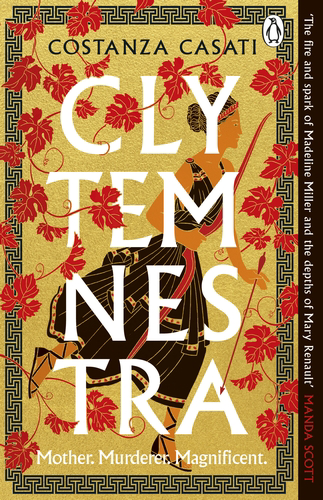
Clytemnestra is known for being the wife of the famous King Agamemnon. He was a true bastard who saw Clytemnestra as someone who challenged him, and he liked that. He brutally murdered her first husband and baby son to ensure he was her only husband. Clytemnestra was calculated, intelligent, and patient. She waited over twenty years to seek her revenge on Agamemnon, and we got to see the journey of strength unfold.
The traditional view of Clytemnestra was a hysterical woman who had everything and killed her husband and the father of her children. Casati portrayed her very differently. Clytemnestra was a Spartan, and Spartan women lead a very different life. Casati portrayed Clytemnestra as a survivor and a warrior who bided her time to avenge the death of a man who loved her and their baby boy.
You develop a view of the life that Spartan women lead and the different life they lead compared to other cities and towns in Greek mythology. There is a lot of fighting, painful moments, longing for the people she loved, and revenge. It was empowering to see a female character be portrayed in a way that she deserved.
I feel that it is necessary to give context to the two completely different worlds that Clytemnestra lived in. She was originally from Sparta and, when she was forced to marry Agamemnon, she moved to Mycenae.
Spartan women are still treated differently to men and are oppressed; however, they are given more of a voice than other women in Greek mythology. Spartan women are encouraged to be strong because strong mothers produce strong warriors, which in turn support their growing army. Girls and women alike are expected to be warriors in Sparta and are expected to train and fight, sometimes to their death. They used to train alongside the boys and men and would often get very hurt. We saw this in the book where Helen and Clytemnestra would train alongside their brothers (Castor and Polydeuces), and their brothers respected them. Clytemnestra gained power and respect through her ability to wrestle and fight, alongside her mental endurance. There were occasions in the book where women had a voice and were allowed to choose the man they married and the city they lived in. There were also times when they were not given a voice.
Mycenae was a different world, and women and children had less of a voice. While Sparta was wealthy, it thrived on military power, and that was the main focus for the King of Sparta and his family. His children were sent to fight and trained, just as other children. Whereas in Mycenae, the center was a wealthy and powerful place with more traditional ways of living. Women were decorative pieces in society; they were noble at their feasts and expected to be silent while the men told their stories.
Clytemnestra’s character developed, and we witnessed her grow from a girl who wanted to protect her sister to a mother who was biding her time. Clytemnestra was intelligent, and she would share her opinion and allow herself to have a voice. Of course, in Mycenae especially, men did not appreciate a woman having a voice (it probably intimidated them), and this caused issues for her. Clytemnestra wanted to survive, and she knew that she would keep surviving until she knew the time was right to take her revenge. We saw her develop as a mother and have children, whom she ensured understood Sparta and where she came from.
Casati shone a light on the relationship between Clytemnestra and her sister, Helen. It was a tragic relationship at times, and also beautiful. For a long time, Clytemnestra lived to protect Helen, and Helen needed Clytemnestra. Unfortunately, when Helen found out her true heritage, the relationship changed and Helen made the wrong choices. The relationship between the sisters developed over time. Clytemnestra was a maternal force in Helen’s life and saved her from rape and potential death. I feel at times that Helen can be misjudged in this book and potentially seen as weak and vulnerable. When in fact, I feel that both women were strong, but in different ways. Clytemnestra was loud, and she was happy to stand up and fight. She would share her opinion and challenge men and women alike. Whereas Helen was quiet and beautiful. Other characters in the book would comment on Helen’s beauty without having a conversation with her. She was often overlooked as anything but beautiful. Although, we learn that her true strength and power is inside her, and the quietest person in the room does not have to be worthless or powerless.
Tyndareus and Agamemnon are the villains in Clytemnestra’s story. Her father and her soon-to-be husband plotted an awful scene which caused the death of her husband and baby. This was orchestrated to build a political alliance and a strong army to prepare for the impending war. Casati built purposeful impact on the reader by allowing a supportive and empowering father to act in such a way towards his daughter. We learnt to hate both men, despite their good qualities.
As mentioned, we saw Clytemnestra develop as a mother. She shared stories with her children and ensured they were strong Spartans as well as intelligent and wise. Motherhood was not easy for Clytemnestra, and she experienced grief and had two children brutally murdered by the same man. The tragedy of Iphigenia drove the plot in my opinion; it solidified the need for revenge for Clytemnestra. Her daughter was promised a husband and a wedding, when instead the kings of their world planned to sacrifice her in front of her mother to the gods of wind to allow their ships to sail. Clytemnestra was strong, but she had to watch both children get brutally murdered by a man in her life. She knew that she had to be strong to gain her revenge. If she showed any weakness, then she would have failed. She stayed for years after the death of her second child. She held the fort, played the role of queen, and waited for the right time.
Within the book, it states, “women must be twice as cruel to be half as respected,” and Clytemnestra encompassed this and knew she had to be cruel to survive. She had to be smart, but she had to work a lot harder to get the respect of men. Spartan women were given respect and freedom while Mycenae was a rigid world for women. Clytemnestra had to manage that so she wasn’t labeled a villain or a monster, which would have led to men disrespecting her even more. She had to intimidate men and prove a point just to gain respect and to not be undermined. For example, Clytemnestra was managing the merchants in Mycenae and they did not want to deal with her; they wanted to deal with the King. After the constant undermining and disrespect, she had to take matters into her own hands. I feel this is a pivotal and brave moment for her because she had to assert herself. She couldn’t be nice to the men who publicly disrespected her, so she sentenced them to death to gain respect.
This book has ignited a new interest in reading about Greek mythology, with a particular focus on the women. I am now reading Circe by Madeline Miller, which I am enjoying. I would give this book 5 stars. Clytemnestra was served a bad hand and she was let down by the men in her life. She was young when her husband and son were brutally murdered, but she was strong, she timed her revenge, and she was cruel but it was all in the name of the people she loved.